
Your birthday tells you how old you are. But it doesn’t tell you the whole story.
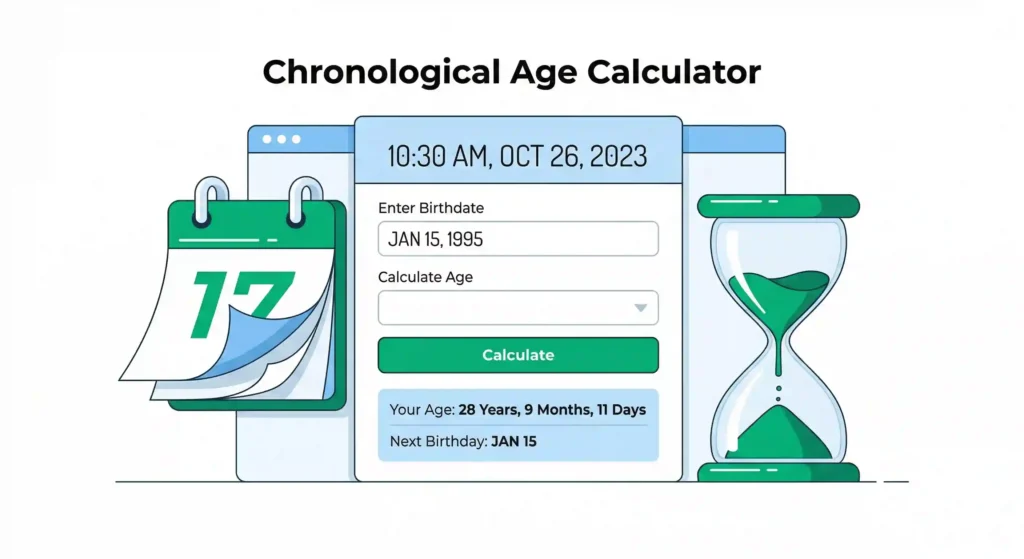
Right now, without doing any math, could you say exactly how many days you’ve been alive? Or how many months old were you when you first walked, started school, or landed your first job? A Chronological Age Calculator answers all of that instantly, down to the exact day.
Whether you’re a parent tracking your child’s developmental milestones, a doctor filling in clinical paperwork, or just someone who wants to know if their 10,000th day alive is coming up soon, this tool does the heavy lifting in seconds.
Table of Contents
What Exactly Is Chronological Age?
Chronological age is the simplest, most objective measure of age there is. It’s the amount of time that has passed since the exact moment you were born, measured in years, months, and days.
No blood test. No fitness assessment. Just math and a calendar.
It’s different from how “old” you feel, how healthy you are, or how young your doctor says your heart is. Chronological age is fixed. It moves at the same pace for everyone, every single day.
Chronological Age vs. Biological Age: What’s the Difference?
This is where it gets interesting. These two types of age are often confused, but they measure completely different things.
Chronological age counts time. Biological age measures how your body is actually ageing at a cellular level. Two people can be the same chronological age but have biological ages that differ by a decade or more, depending on genetics, diet, stress, exercise, and sleep habits.
Here’s a clear side-by-side breakdown:
| Feature | Chronological Age | Biological Age |
|---|---|---|
| Definition | Time elapsed since birth | How old are your body’s cells and systems actually |
| How it’s measured | Calendar math (years, months, days) | Blood biomarkers, DNA methylation, fitness tests |
| Can it change? | No, it moves in one direction only | Yes, it can be improved with lifestyle changes |
| Who uses it? | Everyone, legally and medically | Doctors, researchers, longevity specialists |
| Main factors | Date of birth, current date | Genetics, lifestyle, stress, diet, sleep |
| Accuracy | 100% precise | Varies by testing method |
Knowing your chronological age is non-negotiable for official documents and medical records. Understanding your biological age is optional but genuinely powerful if you’re interested in health and longevity.
How a Chronological Age Calculator Actually Works
At first glance, calculating your exact age sounds trivial. Subtract your birth year from the current year. Done, right?
Not even close.
The real math is surprisingly tricky. Here’s what the calculator is quietly handling every single time you press the button:
Varying month lengths. Months aren’t equal. January has 31 days, February has 28 (or 29), and April has 30. If you were born on January 31st and you’re calculating your age on March 1st, the calculator can’t just subtract days naively; it has to account for the fact that February is shorter than the month you were born in.
Leap years. Every four years (with some exceptions for century years), February gets an extra day. If you were born on February 29th, a simple calculator breaks entirely. A properly built one handles this gracefully by finding your nearest valid birthday in non-leap years.
Day-borrowing logic. When the current day of the month is smaller than your birth day, the calculator “borrows” days from the previous month before subtracting. This is the same logic you learned in elementary school subtraction, but applied to a calendar, which makes it considerably more complex.
The chronological age formula in its most basic form is:
Percent Change = ((V2 – V1) / V1) x 100
And for age specifically:
Age = (End Date – Start Date), broken down into years, then remaining months, then remaining days
The calculator on this page handles all of that automatically. You get a clean result in years, months, and days without once having to think about February.
4 Real-World Reasons You Need to Know Your Exact Age
Knowing you’re “28 years old” is useful. Knowing you’re exactly 28 years, 4 months, and 17 days old? That’s surprisingly powerful in more situations than you’d expect.
Pediatric and Developmental Milestone Tracking
For parents and paediatricians, exact age is everything.
Child development charts are built around precise age windows. A 14-month-old and a 17-month-old are both “1 year old” by birthday count, but their expected developmental milestones are completely different. Speech therapists, occupational therapists, and paediatricians use chronological age calculated to the month and week to determine whether a child is on track or needs early intervention.
This matters even more for premature babies, where clinicians use a concept called corrected age (chronological age minus weeks of prematurity) to set realistic developmental expectations.
If you’re tracking your child’s growth, plugging their date of birth into this calculator gives you the precise age that matches the charts in your paediatrician’s office.
Legal and Administrative Documentation
Age isn’t just a number when it comes to legal matters.
Driving licenses, passports, visa applications, age of consent laws, voting eligibility, senior discount programs, and mandatory retirement ages all hinge on your exact chronological age at a specific date. A single day can make the difference in eligibility for certain programs or penalties for certain violations.
Using a calculate age in years, months and days tool before submitting important paperwork ensures you’re citing the right figure for the right reference date, not just assuming “I turned 18 last year, so I qualify.”
Financial and Retirement Planning
This is one area where being off by even a few months can cost you real money.
Retirement accounts like 401(k)s have specific rules tied to exact age thresholds: penalty-free withdrawals at 59.5, required minimum distributions at 73, and Social Security claiming windows that open on the month of your birthday. If you’re doing Coast FIRE calculations or modelling a pension, you need to know how many months remain until each milestone, not just which year it falls in.
Plugging your birth date into this tool and checking the result against a future target date takes about 10 seconds and gives you a precise timeline to work with.
Fun Milestones and Half-Birthdays
Not everything has to be serious.
Knowing your exact chronological age opens up a whole category of fun personal milestones that most people never think to track. Some examples:
- Your 10,000th day alive (it typically falls sometime in your late 27th year)
- Your half-birthday, exactly 6 months after your birth date
- Your golden birthday, the year you turn the same age as your birth date (if you were born on the 27th, your golden birthday is when you turn 27)
- Counting down to exactly 1 billion seconds of life (that’s around age 31 years and 8 months)
These are genuinely fun numbers to know, share, and celebrate. And none of them is easy to calculate mentally, which is exactly what this tool is for.
Frequently Asked Questions
How do I calculate my chronological age manually?
Start with the current year and subtract your birth year to get a base number of years. Then check whether your birthday has already passed this year. If it hasn’t, subtract one from that number. For months, subtract your birth month from the current month (borrowing from the year if needed). For days, subtract your birth day from the current day (borrowing from the previous month if needed). It’s doable but tedious; using a calculator like this one takes about 3 seconds and eliminates errors.
Does this calculator account for leap years?
Yes. The calculator uses full calendar date logic rather than a fixed “365 days per year” shortcut. This means leap years, varying month lengths, and day-borrowing are all handled correctly. If you were born on February 29th, it correctly calculates your age at any target date without throwing an error.
What is the difference between chronological age and developmental age?
Chronological age is simply how long you’ve been alive. Developmental age refers to the functional level at which a person is performing, regardless of their actual birth date. A 6-year-old with advanced reading skills might have a reading developmental age of 9. In clinical settings, developmental age is assessed through standardized tests and observations, while chronological age is always calculated from the date of birth.
Can I use this to calculate someone else’s age, or an age at a past date?
Absolutely. The “Calculate Age At” field accepts any date, not just today. You can calculate how old your grandmother was on her wedding day, how old a historical figure was at a specific event, or how old your child will be on a future date. Just enter the relevant date of birth and the reference date you want to compare against.
Give It a Try Right Now
Scroll back up, enter your date of birth, and hit calculate. In under five seconds, you’ll know your exact age in years, months, and days, plus your total days alive, next birthday countdown, and zodiac sign.
It’s one of those tools you didn’t know you needed until you see your exact number staring back at you. Go find yours.